
Building an Island
"When a complex system is far from equilibrium, small islands of coherence in a sea of chaos have the capacity to shift the entire system to a higher order."
-Ilya Prigogine, Nobel Laureate in Chemistry
Our last update introduced the Three Horizons framework for navigating systemic change, where the first horizon (H1) describes the system as it currently operates, the third horizon (H3) is the future system, and the second horizon (H2) is the zone of innovation – the bridge, where new ways of doing things emerge.
Horizon 2 work – like affordable housing preservation – sometimes feels like navigating a sea of chaos, exploring beyond the first horizon in a little sailboat, buffeted by storms, stalled in becalmed seas, crashing on rocks, and sometimes reaching beautiful islands where it’s all worth it…
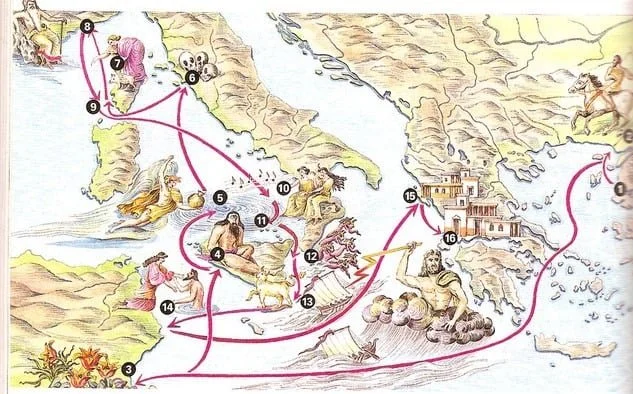
In our first working session on how to apply the Capital Absorption Framework, Robin Hacke – co-founder of the Center for Community Investment – showed us a map of Odysseus’ journey home (above) – a zigzagging line across the Mediterranean, past monsters and whirlpools, seductive sirens and hostile kingdoms, harried at every step by angry gods.
Her point (and the central theme of the Odyssey) was that while his journey was long and circuitous, Odysseus didn't give up. He was resourceful, tough, guided by a clear intention – and he finally made it home.
Islands of Coherence
In the context of our work, “islands of coherence” are markets where policies, programs, and practices are aligned to deliver on shared priorities.
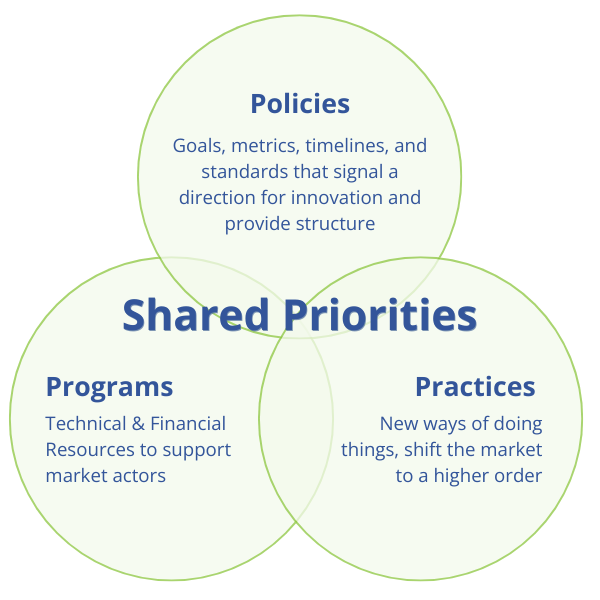
We have policies and programs – some well-established (LIHTC), and some new (ULA, LACAHSA). The work now is to bring them into a coherent structure and deliver on shared priorities.
How do we do this? By doing deals.
In a system organized by money, deals are system events. Innovative deals expand the definition of “what works,” making the pattern legible enough for the next owner, lender, or funder to trust it and repeat it. Deal by deal – that's how we create an island of coherence in LA.
But one island is not enough. It's islands (plural) – Los Angeles and the other cities simultaneously – that shift a chaotic system toward a new equilibrium. With intention, through networks like the Sustainable Communities Investment Accelerator, we can connect these emerging islands to, "shift the entire system to a higher order."
How similar do these islands need to be? How are they connected? How do we navigate between them?
More on this in our next post. For now, we are strapped to the mast!
Monthly Updates
This month, our work moved from organizing a fundraising strategy to defining the capital structure that can close the gap. Blended finance is no longer a concept we are describing; it is the scaffolding for what we are building.
Shared Priorities
Better Neighborhoods, Same Neighbors — everyone should have access to affordable, secure, healthy housing
By 2028, our cohort partners will retrofit 55 properties (almost 2,000 units) in East LA, DTLA, Little Tokyo, and South LA
Strengthening organizational capacity and resident engagement, with tenant comfort and affordability as the shared north star guiding equipment, solar sequencing, and electrification decisions
Share generated data as a catalyst to reform the enabling environment
Pipeline
Captured firsthand construction-management lessons from across the cohort this month, anchoring a new webinar for partners on procurement, oversight, and vendor management.
Esperanza & ELACC completed aggregated-meter Measurabl Connect setup, extending utility-data coverage across the cohort portfolio; moving to individual tenant metering — piloting one building per partner — is next, pending tenant authorization and consent.
ELACC –
Win: Closed out the 115 North Soto and 319 North Cumming Street retrofits, with the final HVAC permit in hand and CAMR/LIWP cashbacks closely matching reserved incentives, and is advancing solar across five properties.
Challenge: LADWP's 30 kW inverter cap is constraining PV system sizing on properties without on-site transformers or three-phase service, requiring workarounds at 115 North Soto and resequencing 319 North Cumming first.
Response: Working with LADWP and AEA to accelerate timeline and deliver savings to tenants, while considering LADWP grid management priorities.
LTSC –
Win: Completed retrofits at Angelina and Casanova that are generating the operational lessons now shaping cohort best practices.
Challenge: All-electric heat pump water heaters are underperforming for larger households, producing cold water or spiked bills, compounded by breakdowns and slow vendor response.
Response: Resident and staff education and engagement, while providing feedback to manufacturers and contractors to address current issues and prevent similar issues in the future.
Esperanza –
Win: Mini-split installs at Via Esperanza delivered first-time cooling to family units, with active work now advancing across four properties.
Challenge: Tenant electricity bills rose after electrification – Esperanza is sequencing solar to offset the increases, but financing for roofs remains a challenge.
Response: Exploring funding options to replace roofs and sequencing future projects to mitigate tenant bill impacts.
Enabling Environment
Program Resilience – With LIWP fully subscribed and no new state funding expected yet, the cohort is planning for a CAMR- and utility-led incentive environment, filing LIWP waitlist reservations to demonstrate demand, and supporting advocacy for a multi-year LIWP extension.
Incentive Reform – Engaging LADWP and AEA on making CAMR less dependent on stacking with state programs, and pushing to compress DWP incentive-payment turnaround from roughly five months toward a six-to-eight-week target.
Fundraising & Capital Structure – Submitted a pre-proposal to the Transformative Climate Communities grant program as a potential source of take-out financing for construction financing; advanced structures to let health-focused grant and PRI capital sit alongside CRA lending and tax-credit equity to close preservation gaps.
Health Co-Benefits – Through our nonprofit, Sustento Initiative, we are building toward investable co-benefit metrics in collaboration with UCLA Fielding School of Public Health, National Lab of the Rockies, and other partners, combining field measurements on indoor air quality and thermal comfort with data-driven modeling to mobilize health-focused grant and PRI capital alongside CRA lending and tax-credit equity.