Our Approach to preservation
The Capital Absorption Framework
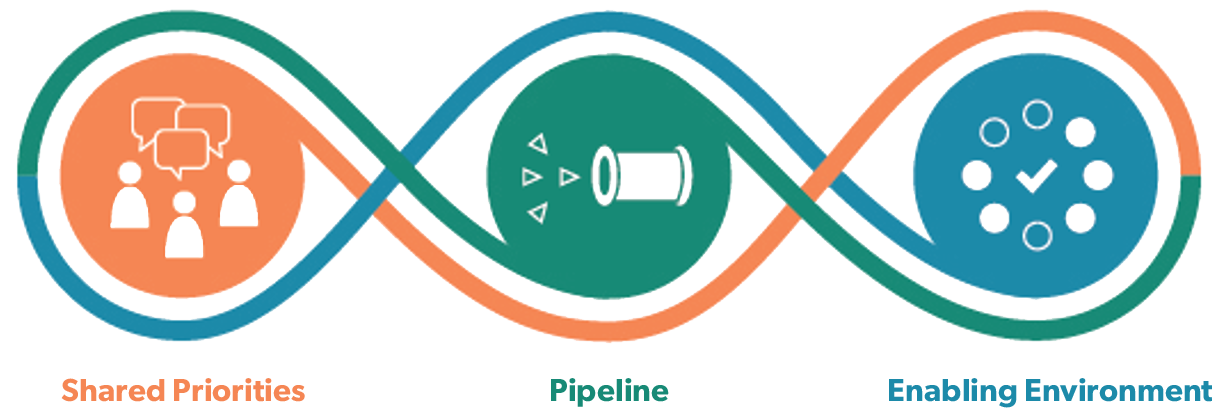
The Capital Absorption Framework is a systems approach developed by the Center for Community Investment that enables affordable housing organizations to access and deploy capital for building improvements effectively.
Rather than treating each retrofit project as a one-off transaction, the Framework creates a structured pathway that helps organizations:
Move preservation initiatives forward more efficiently and effectively
Ensure financial sustainability through strategic capital deployment
Navigate complex financing and implementation systems
Influence the broader investment ecosystem while addressing local building needs
This approach recognizes that affordable housing organizations face unique challenges: limited staff capacity, competing priorities, depleting reserves, and the need to maintain operations while improving buildings. The Framework addresses these realities head-on.

BUILDING IMPROVEMENTS AS PRESERVATION STRATEGY
For affordable housing organizations, building condition is directly tied to organizational sustainability. Comprehensive retrofits are not optional upgrades—they're essential preservation strategies that protect both properties and the organizations' ability to serve communities.
The financial reality is stark: many affordable housing portfolios face reserve depletion, rising maintenance costs, and properties operating at a loss. Emergency repairs consume staff time that should go toward tenant services and community programs. Without intervention, this trajectory threatens organizational viability.
Strategic building improvements reverse this cycle by:
Preventing financial collapse through reduced operating expenses and avoided emergency costs
Extending building lifespan by addressing deferred maintenance and aging systems
Freeing organizational capacity so staff can focus on services, not crisis management
Strengthening resilience against climate impacts, extreme weather, and economic volatility
Improving resident health through better indoor air quality and comfort
Reducing utility burdens for both residents and property owners
These aren't abstract benefits—they're the difference between organizational survival and decline.
Community-based affordable housing organizations serve as first responders during crises. Whether fires, floods, economic shocks, or pandemics, these are the institutions communities turn to when disaster strikes.
Without financial stability and operational capacity, organizations cannot fulfill this critical role. Building preservation, therefore, is community preservation. Investing in these retrofits is investing in the infrastructure of community resilience.

why this matters beyond buildings
Grant support to enable project development and implementation
Coaching and technical assistance throughout the process
Peer learning opportunities through cohort convenings
Financial coordination with lenders to smooth financing and leverage private capital
Community engagement strategies to ensure resident participation and ownership
Field Guide & Resources to support property owners at every stage
Financial coordination with lenders to smooth financing and leverage private capital
Community engagement strategies to ensure resident participation and ownership
Field Guide & Resources to support property owners at every stage
Grant support to enable project development and implementation
Coaching and technical assistance throughout the process
Peer learningopportunities through cohort convenings
OUR MODEL
Retrofit LA provides
Grant support to enable project development and implementation
Coaching and technical assistance throughout the process
Peer learning opportunities through cohort convenings
Financial coordination with lenders to smooth financing and leverage private capital
Community engagement strategies to ensure resident participation and ownership
Field Guide & Resources to support property owners at every stage
Retrofit LA is delivered by Sustento, a social enterprise specializing in market transformation for building resilience.
Sustento provides technical assistance, resource development, program operations, and the tools organizations need to navigate complex retrofit projects from planning through implementation.
-
Better Neighborhoods, Same Neighbors
Preservation of existing affordable housing is faster, greener, and less expensive than new construction. Yet we’re losing existing affordable housing ~10x faster than we’re building new. Now is the moment to come together, to address the underlying factors driving this trend and redesign the system to stabilize our communities.
Preservation = (Rehab + Decarb) + Stabilization
Our initial objective is to fund the Preservation of a “Batch” of 10 properties from within the Retrofit LA Pipeline – treating this “Deal” as a Systems Event, with a goal to push the edge of the possible, show what the system needs, and shift industry and institutional practices to move the system forward.
February Updates
Shared Priorities
Narrative & Storytelling – With support from LADWP, we hosted our second public webinar, focused on best practices in project financing and lessons learned through the development of ELACC’s innovative Revolving Energy Transition Fund (RETR-Fund)
Case Studies – Advanced development of case studies on completed decarbonization projects, which illustrate how decarbonization fits within the broader context of sources and uses for Preservation
Fostering Relationships – Broadened and deepened relationships with industry leaders, including SCANPH, UCLA Ziman Center’s Housing as Healthcare Initiative, and the ULI Randall Lewis Center for Sustainability in Real Estate
Pipeline
Crafting the Deal - Engaged California Housing Partnership to model “the Gap” on our initial “Batch” of 10 properties, which will support engagement with potential capital providers in Q3
Building Shared Infrastructure – In collaboration with Retrofit LA Cohort members and the Center for Community Investment, Sustento is revamping its project and pipeline management system to streamline engagement with potential funders and support future scalability of the initiative
Funding & Capital Structure – In collaboration with the Milken Institute and LADWP, Sustento is engaged with leading CDFIs to co-develop a decarbonization financing pilot program, while engaging money-center banks and philanthropic funders to facilitate the emergence of an ecosystem that can efficiently deliver low-cost blended capital solutions at scale
Enabling Environment
Insurability – Launched collaborations with CA FWD, Enterprise Community Partners, and Milken Institute working groups on resilience, risk mitigation, and insurability
Alignment – Working with Enterprise Community Partners, opened conversations with LADWP and LAHD to improve alignment and coordination of policies, programs, and resources
Health Co-Benefits – Formalized partnerships with UCLA Fielding School of Public Health, Lawrence Berkeley National Lab, and National Lab of the Rockies (formerly NREL) to translate data on thermal comfort and indoor air quality co-benefits into investable metrics
The system is working as designed – and it’s not delivering the results we want. It’s nobody’s fault – but the responsibility falls to all of us to change it.
“Out past ideas of rightdoing and wrongdoing, there is a field. I will meet you there.” – Rumi
Onwards!
David Hodgins
Founder & Chief Executive Officer -
Better Neighborhoods, Same Neighbors
Since announcing Retrofit LA's selection for the Sustainable Communities Investment Accelerator (SCIA) in July 2025, we've been testing assumptions, listening closely, and refining our approach. This is the first in a monthly series sharing what we're learning as frameworks meet real buildings, real balance sheets, and real communities.
Redefining Affordable Housing Preservation
Preservation is often framed narrowly as preventing demolition or market-rate conversion. In practice, it means much more:
Stabilizing existing affordable multifamily assets within nonprofit portfolios
Ensuring long-term affordability, not just short-term compliance
Retrofitting buildings to extend useful life, control costs, improve resilience and insurability, and protect residents from extreme heat and poor air quality
Protecting local, nonprofit ownership
Buying time for the production of new units
Preserving our most important asset: community
Our guiding principle: Better neighborhoods, same neighbors.
Deals are more than transactions:
They are units of progress towards the shared priority
They are shaped by the context in which they take place. By looking at a deal, we can understand the dynamics at work in the enabling environment
They can be interventions in the enabling environment, in which we test or change new ways of working
If deals are implemented as system events that allow for testing, developing, and strengthening elements of the enabling environment, they make future deals more doable and generate new opportunities.
The enabling environment is strengthened through:
Advancing needed policies and regulations
Retooling practices and processes
Applying or combining resources or funding in new ways
Fostering formal and informal relationships that last beyond the deal
Creating forums and platforms for ongoing collaboration
Shifting narratives
Our near-term objective is to preserve a “Batch” of 10 properties totaling 380 units housing more than 1,000 residents. We’re intentionally treating this batch as a system-learning opportunity.
Despite completing significant decarbonization upgrades, all properties are losing money monthly, have limited ability to raise rents, and lack sufficient reserves for urgent non-energy rehabilitation needs.
We're exploring blended capital solutions, including 4% Low-Income Housing Tax Credits, CRA-aligned grants and debt, CDFI financing, program-related investments, and philanthropic capital. Through this first "Deal," we aim to surface barriers embedded in policy, underwriting, and capital stacks—and make future preservation deals easier.
What We Will Produce in 2026
Retrofit LA will generate practical outputs through core collaborative efforts and strategic participation in aligned initiatives:
Case studies quantifying how energy upgrades, operating costs, capital structure, policy, and insurance interact in preservation deals
A Retrofit LA Field Guide distilling three years of partner experience into a streamlined, replicable process
Cross-sector advocacy focused on policy alignment, regulatory reform, and gap-filling capital
Our priority focus areas:
Funding & Capital Structure – developing a dedicated, blended-capital preservation fund
Health & Social Co-benefits – advancing shared metrics connecting preservation with resident health outcomes
Insurability – mapping how upgrades affect insurance availability and cost
Narrative & Storytelling – building communications to grow the network and sustain this work
Building Shared Infrastructure
Our ambition extends beyond a single "Deal." We envision Retrofit LA evolving into durable shared infrastructure that supports affordable housing providers across Los Angeles as they stabilize, decarbonize, and futureproof existing portfolios.
By grounding systems change in real transactions and real communities, Retrofit LA is demonstrating what it takes to preserve affordability at scale—not by displacing residents, but by ensuring they can stay.
More to come next month as this work continues.
David Hodgins
Founder & Chief Executive Officer
SIGN UP
FOR UPDATES
Stay updated with the latest news, updates, and special events.