
The preservation paradox
"Which came first, the chicken or the egg?" - Plutarch
Most of us dismiss this ancient (!!!) paradox without fully engaging with it. We tell ourselves it’s just a silly riddle, it’s not important – but the truth is, it’s too uncomfortable to face the fact that we just don’t know. So, we toss it aside and move on to something easier, something “more important”.
The same thing happens when we look at affordable housing preservation. It's too hard. The system is too broken. Move on to something we can wrap our heads around.
But we can no longer afford to look away – “the chickens are coming home to roost.”
The Preservation Paradox
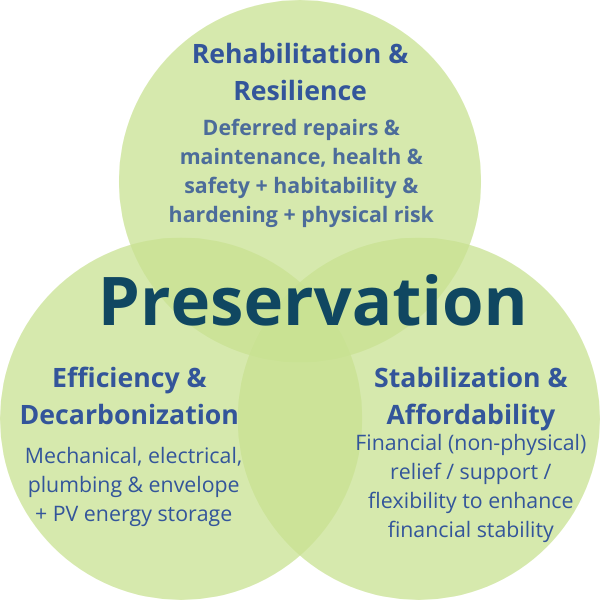
Our existing affordable housing stock is on a dangerous financial trajectory, but it’s hard to justify rent increases without making the repairs and upgrades that residents expect. Likewise, it’s hard to fund repairs and upgrades if buildings are losing money, which also means you can’t easily refinance.
So, which comes first? Rehab? Stabilization? Decarbonization?
The Path of Least Resistance
When we stay with the paradox and zoom out to a systems perspective, a counterintuitive pathway begins to emerge.
What we call “decarbonization” – a.k.a. mechanical, electrical and plumbing systems upgrades – typically represent ~30 - 50% of a property’s total physical needs. In LA, incentives for decarbonization come with no-cost Technical Assistance and are awarded on a first-come-first-served basis – they're not competitive in the same way as tax credits or other traditional funding sources. And when you combine all the incentives, you can get 50% - 100% of your decarbonization costs reimbursed when the project is complete.
Well, what about the upfront cost? CDFIs can provide bridge financing; philanthropic dollars can fill gaps; and, going back to the Venn Diagram, making these upgrades delivers huge co-benefits for residents, like access to cooling, better indoor air quality, and maybe most important – a sense that they are being invested in.
Resolving the Preservation Paradox
In the words of Alan Watts, "[a] chicken is just one egg's way of becoming other eggs." Which is a poetic (and funny) way of telling us there must be an answer, but we will never know for sure – so all that’s left is to dance with the not knowing, and do our best to move toward what is true and good.
Decarbonization offers a logical starting point to resolving the Preservation Paradox, inviting residents into conversation, addressing a good chunk of a building’s needs, activating the enabling environment, and building trust – which is the foundation for progress.
Moving together in this way, we create space for the emergence of novel community investment models that will carry us into the future we choose.
Monthly Updates
We remain focused on our primary objective: to fund the full Preservation of our Cohort pipeline, starting with a batch of 9 properties – treating the “Deal” as a Systems Event – with a goal to demonstrate what’s possible today while catalyzing shifts in the enabling environment to make future deals easier.
Capital Absorption Framework

Shared Priorities
Better Neighborhoods, Same Neighbors
Everyone should have access to affordable, secure, healthy housing
By 2028, our cohort partners will:
Retrofit 55 properties (almost 2,000 units) in East LA, DTLA, Little Tokyo, and South LA
Strengthen organizational capacity & resident engagement
Share generated data as a catalyst to reform the enabling environment
Pipeline
We are segmenting the pipeline into tranches, running on parallel tracks, based on the properties’ physical and financial needs, decarbonization incentive coverage, lead time / stage of development, viability of related funding sources for rehab and stabilization, and other relevant factors.
TRANCHE 1 - Completed – $10.8M Decarb Retrofits
Retrofit LA Cohort Members have completed Phase 1 Decarbonization retrofits across 9 properties encompassing 365 units, leveraging ~$10.8M in decarbonization incentives to cover ~100% of project costs
Phase 2 Decarbonization will include solar PV and new roofs, at an estimated investment of $3.6M, bidding in process now
Remaining gaps for Rehab & Stabilization depend on ULA and LACAHSA awards
TRANCHE 2 - In Development – ~$37.6M Decarb Retrofits
25 properties — 764 units
Decarbonization interest forms submitted, scoping underway
Will seek funding for decarb, rehab, and stabilization, including grants and PRI to sustain and scale the work
6 – 18 months estimated lead time
TRANCHE 3 - In Queue – ~$38.4M Decarb Retrofits
21 properties — 829 units
Decarbonization interest forms submitted, scoping not started
Will seek funding for decarb, rehab, and stabilization, including grants and PRI to sustain and scale the work
12 – 24 months estimated lead time
Enabling Environment
Insurability – Continued collaborations with CA FWD, Enterprise Community Partners, and Milken Institute working groups on resilience, risk mitigation, and insurability
Alignment – Working with Enterprise Community Partners, continued work with LADWP and LAHD to improve alignment and coordination of policies, programs, and resources
Health Co-Benefits – Advanced research with UCLA Fielding School of Public Health, Lawrence Berkeley National Lab, and National Lab of the Rockies (formerly NREL) to translate data on thermal comfort and indoor air quality co-benefits into investable metrics to mobilize health-focused capital.
Resolving the Preservation Paradox
In the words of Alan Watts, "[a] chicken is just one egg's way of becoming other eggs." Which I think is a poetic (and funny) way of telling us there must be an answer, but we will never know for sure – so all that’s left is to dance with the not knowing, and do our best to move toward what is true and good.
Decarbonization offers a logical starting point to resolving the Preservation Paradox, inviting residents into conversation, addressing a good chunk of a building’s needs, activating the enabling environment, and building trust – which is the foundation for progress.
Moving together in this way, we create space for the emergence of novel community investment models that will carry us into the future we choose.