


Introduction & Field Guide Overview
Guide Sections
1. Introduction & Field Guide Overview
COMING SOON
2. Getting Started
3. Funding Your Project
4. Reviewing Your Portfolio
5. Selecting Properties
6. Engaging Tenants
7. Developing a Scope of Work
8. Selecting a Contractor
9. Financing
10. Construction
11. Conducting QA & Verification
12. Monitoring Utility Use
13. Managing Operations and Maintenance
14. Future Learning
15. Resources & Case Studies
16. Appendix
Introduction & Field Guide Overview
Preservation through Decarbonization - Better Neighborhoods, Same Neighbors
The goal of affordable housing preservation is simple: keep communities intact. While protecting affordable homes from market-rate conversion, demolition, and rising rents, is necessary and important, these are not the most impactful outcomes. Improving the quality of life for residents, extending the useful life of buildings, maintaining local ownership, and sustaining long-standing community are why this work goes beyond buildings and towards building better neighborhoods for those that need it most.
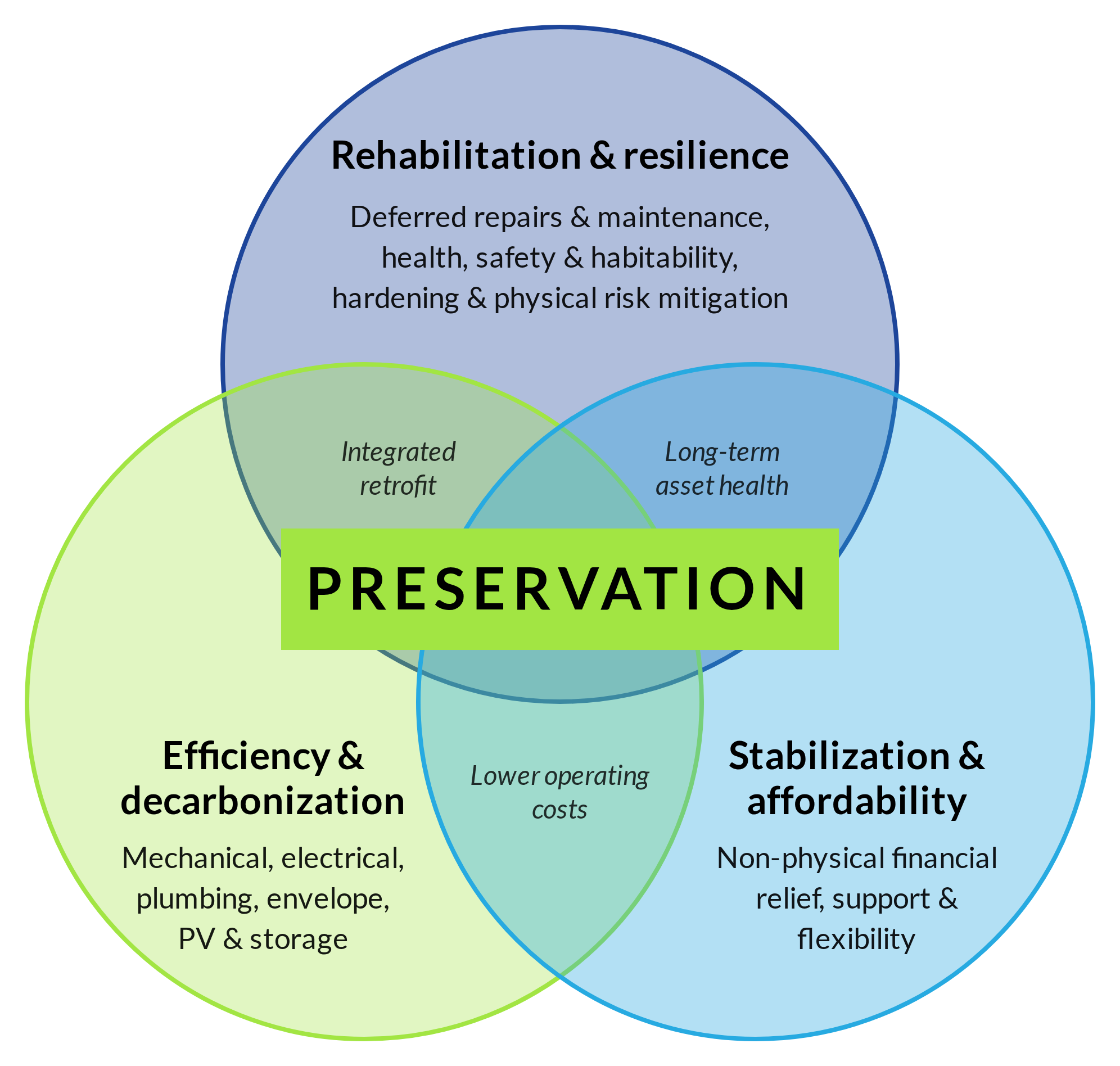
There are two ways to expand the supply of affordable housing and prevent displacement:
Build new homes
Preserve the homes we have
Both matter. But preservation is cheaper, faster, and greener than new construction. Reusing existing buildings is not a fallback. It supports the same goal as new construction: creating lasting, affordable homes for the communities served.
Retrofitting existing affordable multifamily housing is a cross-cutting strategy. If done well, it can control operating expenses, stabilize assets, preserve affordability, and enhance insurability, all at the same time. With careful planning, decarbonization and resilience can also address health outcomes, reduce pollution, and extend the life of buildings that communities depend on. Every time a building is upgraded to be safer, healthier, and more efficient, families are able to stay in their communities for the long-term.
While a range of funding and policy tools exist to support preservation, these are complex, competitive, and have historically deprioritized decarbonization and resilience relative to more immediate needs.
Decarbonization, which has long been positioned as a “nice to have,” is in fact a major component of the rehab work that many affordable housing properties now need, as mechanical, electrical, plumbing, and building envelope systems reach the end of their useful life. Resilience is no longer a future concern; extreme heat is now the #1 public health risk in Los Angeles and 30% of affordable housing units have no cooling of any kind. Regulation is following: Los Angeles County has adopted a maximum indoor temperature standard for rental housing (82°F), and the City of Los Angeles is considering a similar measure.
Decarbonization incentives provide a strategic advantage for property rehabilitation. By utilizing deep subsidies that are less competitive and independent of a property’s financial health, owners can address rehab needs while generating the health and social co-benefits required to secure additional funding from other sources.
In an environment of limited resources and compounding challenges, affordable housing providers must think holistically and implement strategies that leverage resources to solve multiple issues at once. Decarbonization offers a foothold. This Field Guide is designed to help.
How is this resource different?
Several field guides, roadmaps, and toolkits already exist, but many apply to all building types, are not specific to any particular market, and are written from an external perspective. This RLA Field Guide is different. It documents our partners' experience over the past 3+ years and distills their collective learnings into an actionable process. It contains supporting resources, designed by and for local nonprofit affordable housing providers in Los Angeles.
That experience matters because this work is genuinely complex. Knowing how to select the right buildings, line up funding, leverage free technical assistance, navigate contractors, and coordinate inspections, all while keeping tenants in their homes, is difficult. Most affordable housing providers are starting with limited staff and no prior decarbonization experience. Our partner East LA Community Corporation started exactly that way and has since completed two projects, with a third underway.
The guide also recognizes that decarbonization is and must be part of a more holistic, affordable housing preservation strategy, not a stand-alone effort. Throughout, we consider how the physical and financial work of decarbonization can be coordinated with efforts to secure funding and meet local regulatory requirements, not just for decarbonization, but also for health and safety.
Through real-world examples and case studies, we illuminate the issues, systemic barriers, and practical trade-offs a retrofit involves, and share specific strategies to avoid pitfalls. We call it a Field Guide because it is more than a roadmap or a toolkit.
A note on approach: throughout this guide, the mantra is measure twice, cut once. Plan well. Engage your team early. Communicate clearly with your board, your contractors, and your tenants. Surprises will still happen; every project encounters them. But the organization that navigate them best are the ones that built the right process from the start. This guide is designed to help you do just that.
Purpose
This Field Guide is designed to help affordable housing providers in Los Angeles plan and complete building decarbonization retrofits. Drawing on the benefit of hindsight from our partners’ direct experience, it structures information, streamlines the effort, and provides rules of thumb to enable better planning and decision-making, covering everything from change orders and tenant engagement to the ongoing operation and maintenance of new equipment.
Using This Field Guide
This is a practical guide for planning and completing a building decarbonization retrofit, from portfolio prioritization, to building internal buy-in, to project selection, and construction. Each section outlines a clear process that can be adapted to fit your organization’s capacity and property types.
You will find tools, examples, and checklists drawn from real projects across Los Angeles to help you move step-by-step through this process, from building readiness and funding strategies to construction, tenant engagement, and long-term maintenance. By following these steps, your team can strengthen housing stability while contributing to a cleaner and more resilient city.
How this guide is organized. The fifteen sections (coming soon) follow the arc of a project in four movements. Assessment (Sections 2–5): organizational readiness, funding strategy, portfolio review, and property selection. Planning (Sections 6–9): tenant engagement, scope of work, contractor selection, and financing. Implementation (Sections 10–11): construction and quality assurance. Verification (Sections 12–15): monitoring, maintenance, lessons for your next project, and the case studies behind this guide.
You do not have to read front to back. If you are launching a single project rather than a portfolio strategy, start with Section 5 and the case studies in Section 15, then return to Sections 3 and 4 when you plan your next building.
To provide a comprehensive field guide, we have included worksheets throughout that can be accessed on the resources or appendix page. This field guide uses the following reference system:
Tables
Format: Table S[Section]-T[Number]: [Table Name]
Example: Table S2-T1: Summary of Team Roles
Appendices
Format: S[Section]-A[Number]: [Name]
Example: S2-A1: SWOT Analysis
This Field Guide was written by Sustento and draws from the direct experience of East LA Community Corporation (ELACC), Little Tokyo Service Center (LTSC), Esperanza Community Housing (Esperanza), and the Los Angeles Department of Water and Power (LADWP), with input from the California Housing Partnership (CHP) and the Center for Community Investment (CCI). It was developed with funding from LADWP, the Center for Community Investment, and TECH Clean California, and with support from the Wells Fargo Foundation.
Any questions? Contact us for more information.