


Funding your project
funding your project
Start by looking at how much money your organization already has. Review your property’s operating budgets, replacement reserves, and any unrestricted funds that could help pay for energy upgrades. Also, check how your current capital improvement plans match the decarbonization work you want to do. Use the Financial Capacity Assessment (Appendix S3-A1) to keep a record of these details.
When thinking about how much you will spend, remember to look at all of the building’s needs, not just one upgrade. Decarbonization should fit into the property’s full list of repairs and improvements.
Understanding Typical Project Economics
Cost per unit (about $20,000–$30,000 each)
Most buildings will need about $20,000–$30,000 for every apartment to make energy upgrades. This is a rough estimate and can change based on the building.
Electrical Infrastructure ($15,000–$20,000 per unit)
Many older buildings need new electrical wiring or bigger electrical load capacities, so they can safely use new electric equipment.
Incentives (pay part of the cost, paid after work is done)
Incentive programs can help pay 30-80% of the project cost, but they usually pay after the upgrades are finished. You must complete applications and follow program rules to receive the money.
How decarbonization fits into your building’s overall needs (PNA)
Every building has a list of repairs it needs, usually determined by a Physical Needs Assessment (PNA). This includes things like safety repairs, fixing old systems, removing mold or pests, and making buildings accessible. About half of these repairs involve systems that connect closely with decarbonization, such as:
Mechanical: heating, cooling, and ventilation
Electrical: wiring, lights, and appliances
Plumbing: water heating and pipes
Planning upgrades at the same time helps prevent a ‘domino effect’, where old systems break down one after another and cause bigger, more expensive problems later (for additional information read “Avoiding the Domino Effect” by Enterprise Community).
Funding Options
Reserves
This is the money your organization has already saved that can be used for the project.
Grants
These are free funds for which you can apply. They do not need to be paid back, but they usually require applications, paperwork, and reporting. Grants are also the most flexible source: unlike incentives, they can fund staffing, capacity, and gap costs. Line them up before construction begins.
Re-fi / Re-syndication Proceeds
This means putting the property into a new tax-credit deal or refinancing it. Doing this can bring in new money to help pay for large upgrades.
Incentives
Eligibility: Many incentives require buildings to have 5 or more units and serve low-income households. For buildings too small to qualify (ELACC had a 3-unit property that could not use CAMR), The Switch is On portal can help layer incentives on smaller projects.
Typical cost coverage: Programs often cover part of the project cost, which can make upgrades much more affordable.
Local Incentives:
Comprehensive Affordable Multifamily Retrofits Program (CAMR):
Los Angeles Department of Water and Power (LADWP) program that provides free building assessments, technical assistance, and financial incentives for low-income multifamily owners. Eligibility generally requires that two-thirds of units serve households at or below 80% of AMI.
GoZero (AQMD):
Pilot program from the South Coast Air Quality Management District that gives rebates for all-electric heating and hot-water systems, replacing old gas or propane equipment in multifamily buildings.
State Incentives:
Low-Income Weatherization Program (LIWP):
A statewide program in California that provides free technical help, incentives, solar panels, and energy-efficiency upgrades for low-income multifamily buildings.
A statewide program in California that provides incentives, training, and technical support to help properties install electric heat-pump water heaters and other clean-energy equipment.
Stacking Funding Sources
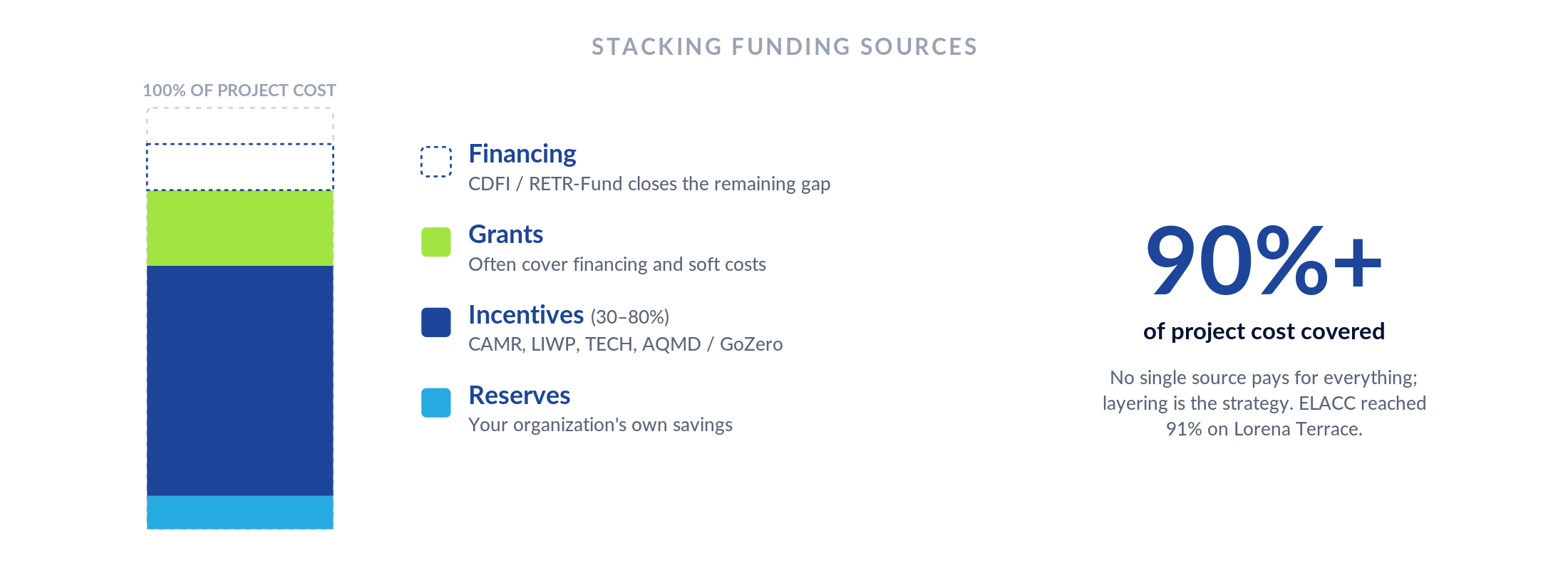
No single program pays for everything, and that’s by design. What makes projects financially viable is stacking: layering reserves, incentives, grants, and financing together to close the gap. Each one helps. The right combination can reach 90%+ cost coverage. ELACC reached 91% on Lorena Terrace using four programs (CAMR, LIWP, TECH, and AQMD/GoZero), with grants covering financing costs and the RETR-Fund filling the remainder (explained in a later section). Stacking multiple incentives doesn’t just close gaps; it preserves reserves for future maintenance, keeping buildings affordable longer.
Two practical notes on stacking. First, coverage percentages depend on how soft costs (permitting, insurance, construction interest) are counted, so confirm which costs each program treats as incentive-eligible before quoting a coverage number. Second, decarbonization incentives can be combined with rehab-side sources such as United to House LA (ULA) funds, LAHD programs, and LACAHSA funding rounds, so one construction mobilization can address both scopes.
California Incentive Chart (Appendix S3-A4)
Use this linked chart to see what programs your building qualifies for, what each program pays for, and which ones can be combined.
Incentives vs. Grants
While both incentives and grants offer financial support, they are quite distinct. Both incentives and grants will require you to collect data, have an implementation plan/timeline, and execute an agreement. Even though you may use the same information for different grants/incentives, each will have different requirements and deadlines. Use this Incentives and Grants Tracker (Appendix S3-A2) to keep track of the eligibility criteria and compliance periods for each funding source. Securing both types of sources will enhance the financial feasibility of your decarbonization projects.
| Table S3-T1: A Comparison of Incentives and Grants | |
| Incentives | Grants |
|---|---|
| Also known as rebates, the purpose of incentives is to encourage energy efficiency or renewable energy upgrades | The purpose is to support large-scale projects or initiatives that align with their own goals (e.g. decarbonization, sustainability or housing development) |
| Funded by the government and/or utility companies | Funded by foundations, organizations, or government |
| Typically tied to a specific action (e.g. low flow aerator installation requirement) and covers a portion of the costs | Typically, more flexible than incentives, no specific requirements |
| To apply must fill out an application form | To apply you may need to fill out an application, which usually requires storytelling/narrative work |
| Must show proof of installation before incentive or rebate can be received | Can be awarded during any phase of the project |
Finding Grants
First check this resource Available Incentives and Grants (Appendix S3-A3 - Coming Soon) for a list of incentives and grants you can research. Then look over this spreadsheet for a more detailed breakdown of eligibility requirements, eligible measures, incentive amount, etc., for incentives available in California and Los Angeles, Incentives and Grants in CA/LA (Appendix S3-A4).
To find grants, you can either search the web or local, state, and federal databases such as the Department of Energy, EPA, and local government portals. Use keywords, such as those listed in the table below to filter results.
| Table S3-T2: Keywords | ||
| Decarbonization | Building decarbonization | Affordable housing retrofit |
| Energy efficiency | Sustainable development | Green (grants) |
| Solar energy | Net-zero tech(nology) | Low carbon tech(nology) |
| Zero carbon tech(nology) | Renewable energy | Decarb |
Applying for Incentives
To apply for incentives there are four general steps:
Researching Available Incentives: Use tools such as the Retrofit LA Energy Rebate Navigator to identify local energy rebate programs.
Preparing Documentation: Have utility consumption data, financials, and capital needs assessment ready (discussed in Field Guide - Section 5)
Submitting Applications: Review requirements and deadlines for each program, ensuring all necessary documentation is complete.
Monitoring Progress: Keep track of deadlines and program cycles. Assign team members to follow up on application status and track funding received.
Additional resources include:
LEAN Deep Energy Retrofit Pathway (leanmultifamily.org)
Financing Options
Contractor Financing
Some contractors can pay for the work upfront and get paid back after construction is finished. This is the most common option. The project scope is usually limited to the parts that are covered by incentives, because the contractor is taking on the financial risk. Owners still need to bring together whatever they can, from reserves and grants, to close any financial gaps. Little Tokyo Service Center used this model successfully with Optima Energy, which floated equipment and installation costs until incentive payments arrived.
CDFI Financing
Community Development Financial Institutions (CDFIs) offer loans designed for affordable housing and energy upgrade projects. They can provide flexible funding when owners do not have enough reserves or when incentives do not cover enough of the cost.
One innovative approach worth exploring is the Revolving Energy Transition & Resilience Fund (RETR-Fund), a financing structure pioneered with two CDFIs, the Housing Partnership Fund and Raza Development Fund. Together they funded a $3 million credit facility at the parent organization level rather than the asset level. The debt sits with ELACC as an organization, not with any individual property. As incentives arrive after each project is completed, they repay the facility, which then revolves and becomes available for the next building. One facility funds multiple projects with no new origination costs each time.
Why this structure works:
Healthier properties in the portfolio can effectively support ones that would not qualify for financing on their own.
Because no debt sits on individual building assets, you avoid the need for existing asset-level lender consent.
Incentives recycle through the portfolio, and the facility revolves continuously, enabling ongoing projects.
Philanthropic funding can reduce transaction costs.
It is a line of credit: no interest accrues until funds are drawn, and ELACC draws only after incentive reservations are confirmed, so there is no risk of carrying interest on incentives that fall through.
The facility scales with the parent entity's capacity to execute, since underwriting is based on the organization's overall credit plus the economics of projects in development.
Operating Gap Fund (in-development)
Where the RETR-Fund bridges construction costs until incentives arrive, the Operating Gap Fund is a low-interest, entity-level loan (roughly six years) sized to a property’s operating deficit. It stabilizes cash flow immediately while income-based, tiered rent adjustments phase in, and repays at a liquidity event.
Other financing options
Energy-as-a-Service or Energy Service Agreements are another way to pay for upgrades, but they are the least common. These contracts can be hard to understand and are usually more expensive because they are structured to meet specific financial and accounting rules. They may work for some owners, but most organizations choose simpler options first.
No Reserves Available
If your organization has little or no money saved, you will need to rely on external financing. Look for lenders who understand affordable housing, energy upgrades, and the timing of incentive payments. Typical options include traditional loans, green financing programs, revolving loan funds, and credit-enhancement programs that help lower risk for the lender.
Start with lenders you already have a relationship with. They know your organization, they've seen your financials, and they're more likely to be flexible. Only after you've exhausted that conversation should you move to new lenders. When you do, look specifically for CDFIs with experience in both affordable housing and energy retrofits.
Co-Benefits
The financial case for decarbonization is compelling, but the benefits go beyond the spreadsheet. When you upgrade building systems, you are also improving the daily lives of the people who live there and strengthening the long-term health of the asset. For tenants the most immediate benefits are health benefits, so the list starts there. These co-benefits are real, and they are increasingly recognized by insurers, lenders, and funders.
Health and Social Benefits
Residents experience better health, fewer asthma triggers, lower noise, and more stable living conditions. But the benefits go beyond comfort:
Heat-related health risks decrease: In Los Angeles County, heat contributes to an average of 12 deaths per year, most among residents without access to cooling.
Medical costs go down. Upgrades can reduce heat-related ER visits by up to 50%, lowering medical strain for families and local health systems.
Better sleep and mental health. Safe indoor temperatures reduce stress, improve mood, and support stable daily routines.
Higher work productivity: When homes are too hot, residents miss work or lose income. Reliable cooling and heating support steady employment and fewer health-related absences.
Lower tenant turnover: Comfortable, healthier homes reduce tenant moves and help maintain long-term community stability.
Thermal Comfort
New electric heat pumps give residents better and, in some cases, totally new heating and cooling, keeping apartments more comfortable year-round. Comfortable indoor temperatures reduce stress and support better sleep, noticeably improving communities.
Indoor Environmental Quality
Cleaner, modern systems improve air quality, reduce drafts, and cut down on moisture problems that lead to mold or unpleasant odors. Better air quality is tied to fewer emergency room visits and fewer missed workdays.
Resilience
Energy upgrades help buildings stay safe and livable during heat waves, power outages, or extreme weather, making the property stronger in a climate emergency. This level of resilience protects both residents and the long-term value of the property.
Insurability
Upgrading building systems can make your property safer and easier to insure.
These Co-Benefits strengthen the surrounding neighborhood and boost the local economy, making decarbonization a strong investment in both housing and community well-being.
Your Funding Roadmap
Use the following six steps to move from financial assessment to a funded project:
Assess Current Financial Capacity: Review operating budgets, replacement reserves, unrestricted funds, and current capital improvement plans.
Identify Eligible Incentives: Start with CAMR. If your project qualifies, it will typically unlock eligibility for LIWP, TECH, and AQMD/GoZero as well.
Build a Funding Stack Strategy: Layer reserves, incentives, grants, and financing. No single program pays for everything; the right combination can cover 90%+ of costs.
Connect with Financing Partners: Start with existing lender relationships. Consider contractor financing and CDFIs. Map your internal decision process and required approvals before going far down this path.
Use Tracking Tools: Use the Funding Sources Matrix and Lender Evaluation Matrix (Appendices S3-A5 and S3-A6) to compare options systematically.
Stay Organized and Document Everything: Keep all documentation for each incentive, grant, and financing source together. Compliance documentation is required to receive payments and will also support future grant applications and reporting.
Track Your Funding Options
Use the Funding Sources Matrix (Appendix S3-A5) to keep track of the funding options you’re considering. Once you have identified potential lenders, you will need to evaluate them. Review the Lender Evaluation Matrix (Appendix S3-A6) to compare terms, requirements, and track records. Focus on lenders that offer favorable terms for energy-related upgrades and have experience in affordable housing and energy retrofits.
Once you know what funding is realistic, the next step is understanding your buildings well enough to decide where that funding should go first.
Any questions? Contact us for more information.